Designing a Four-Season Patio: Comfort Solutions for Northern California
Reading time: 14 minutes
Picture this: It’s a crisp January morning in Sacramento. Your neighbors are huddled indoors, but you’re sitting on your patio with a hot coffee, wrapped in the gentle warmth of a radiant overhead heater, watching fog drift across the oak-dotted hills. That’s not a fantasy — it’s the everyday reality that a well-designed four-season patio can deliver right here in Northern California.
Northern California’s climate is one of the most misunderstood in the country. Outsiders assume “California” means perpetual sunshine, but residents of the Bay Area, Sacramento Valley, and the foothills know better. Summers can push past 105°F in Redding. Winter evenings in Napa routinely dip into the 30s. The delta breeze rolls through Stockton with surprising ferocity in late afternoon. And then there’s the fog — thick, persistent, and atmospheric in its own right.
The good news? These climate quirks are entirely manageable. With the right structural, thermal, and aesthetic decisions, your patio can function beautifully in all four seasons — not as a compromise, but as an intentional extension of your living space. This guide walks you through exactly how to make that happen.
Table of Contents
- Understanding Northern California’s Four Seasons
- The Structural Foundation: Covers, Enclosures & Shade
- Heating and Cooling Strategies That Actually Work
- Flooring, Furniture, and Material Selection
- Lighting and Ambiance for Year-Round Use
- Real-World Examples: Three NorCal Transformations
- Climate Comfort Ratings by Season
- Patio Cover Options: Comparative Analysis
- Frequently Asked Questions
- Your Four-Season Patio Blueprint: Next Steps
Understanding Northern California’s Four Seasons
Before you invest in furniture, heaters, or pergolas, you need to understand exactly what you’re designing for. Northern California doesn’t have the four seasons of Minnesota or Vermont, but it absolutely has its own distinct seasonal personality — and ignoring those patterns is the number-one design mistake homeowners make.
What NorCal Weather Actually Looks Like Season by Season
Spring (March–May): This is arguably Northern California’s most beautiful season. Temperatures in the Central Valley hover between 55°F and 75°F, wildflowers bloom across the foothills, and rain — while tapering off — still arrives in bursts. The Bay Area sees its infamous “June Gloom” creeping in early, with morning marine layer burning off by noon. Patios need to handle intermittent rain and cool mornings, while still being functional by early afternoon.
Summer (June–September): Inland areas like Sacramento, Fresno, and Redding experience intense heat. According to NOAA’s 2025 California Climate Report, Sacramento recorded an average of 38 days above 95°F in 2025 — a number that has increased 22% over the past decade. Coastal zones and the Bay Area stay cooler but deal with afternoon winds and persistent fog. Your patio needs serious shade, ventilation strategy, and possibly cooling mechanisms during this period.
Fall (October–November): This is the sweet spot. Temperatures moderate, the air turns crisp, and humidity drops. Outdoor living is genuinely pleasant with minimal intervention. However, wildfire smoke — a growing reality in NorCal — can make outdoor air quality unpredictable. In 2025, the Bay Area experienced seven Air Quality Alert days in October alone, according to the Bay Area Air Quality Management District.
Winter (December–February): NorCal winters are mild by national standards but genuinely cool. Sacramento averages lows in the low 40s°F. The Bay Area sees sustained cold foggy mornings. Wine Country can experience hard freezes. Rain arrives regularly from atmospheric rivers. Without the right cover and heating, your patio becomes a storage unit for half the year — which is exactly the fate we’re here to avoid.
Pro Tip: Map your patio’s sun exposure throughout the year before purchasing anything. A patio that gets full southern sun in winter (valuable for warmth) may become completely untenable in July without overhead shade. Apps like Sun Surveyor or a simple compass bearing can save you thousands in retrofitting costs.
The Structural Foundation: Covers, Enclosures & Shade
The single most impactful investment you can make in a four-season patio is overhead structure. Everything else — heaters, fans, furniture — operates within a framework that a quality cover defines. Get the structure right, and everything else becomes easier and more effective.
Pergolas, Lattice, and Open Structures
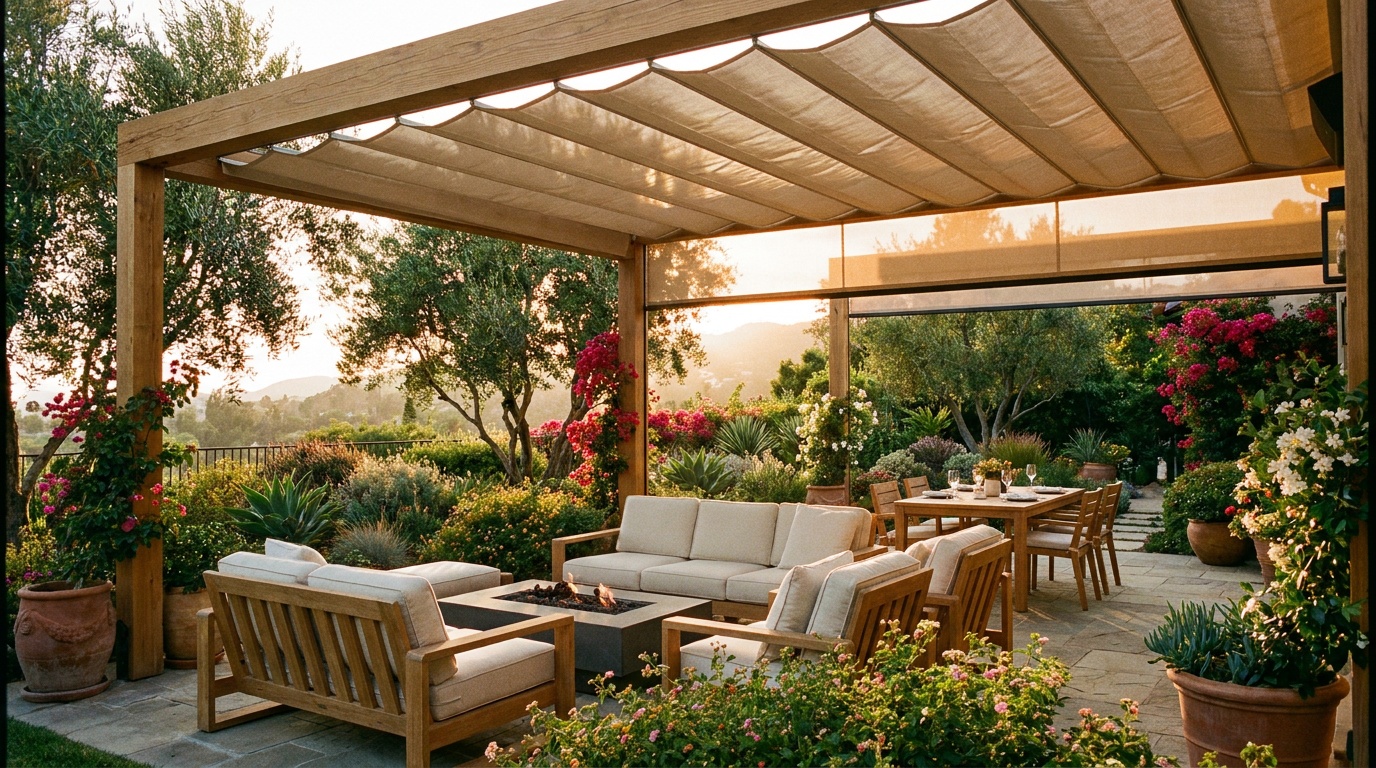
Traditional open pergolas offer shade and visual appeal but provide zero rain protection. They’re perfect for the Bay Area’s dry summers and spring afternoons, but fall short when November rain arrives. Louvered pergola systems — adjustable-slat roof systems from brands like Struxure, Liferoom, and Sunbrella’s AlphaSpace — have surged in popularity across Northern California in 2025–2026. These systems allow you to open the slats for sunlight and ventilation, or close them completely within seconds via remote or app control during a sudden downpour.
In 2026, louvered pergola systems range from $12,000–$35,000 installed for a 400-square-foot patio, depending on materials (aluminum vs. powder-coated steel) and automation features. That sounds significant, but consider: a well-built louvered system effectively adds usable square footage to your home 10–11 months per year in the NorCal climate, delivering functional value that far exceeds most other outdoor renovations.
Full Enclosures and Screen Systems
For homeowners who want maximum year-round functionality — especially in higher-elevation areas like Grass Valley, Placerville, or El Dorado Hills — full or partial enclosure creates what designers now call a “climate vestibule”: a transitional space that isn’t quite indoors but is fully protected. Options include:
- Retractable screen systems: Motorized Phifer or Serge Ferrari screen panels that roll down from the pergola frame, blocking wind and insects while maintaining visibility and ventilation. Cost: $3,000–$8,000 for perimeter screening.
- Clear vinyl panels: Older but effective, these can be zip-tied or snapped into place seasonally. Less elegant but budget-friendly at $500–$2,000 for a standard patio.
- Glass panel enclosures: The premium option. Bi-fold or sliding glass systems create a genuine sunroom that can be fully opened in summer. Installed costs run $25,000–$60,000, but the result is a year-round room that requires no compromise.
The key principle here is modularity. NorCal’s mild shoulder seasons mean you won’t always want a fully enclosed space. Systems that allow partial or full opening on beautiful days — then button up completely against December rain — outperform fixed solutions almost universally.
Heating and Cooling Strategies That Actually Work
Here’s the straight talk on outdoor climate control: most homeowners buy too little heat and no cooling, then wonder why their patio sits unused six months a year. A genuine four-season approach requires intentional thermal design from the start.
Heating Solutions for NorCal Conditions
Infrared Radiant Heaters are the gold standard for covered patios in Northern California. Unlike propane mushroom heaters that waste energy heating the air (which then dissipates immediately), infrared heaters warm objects and people directly — the same principle as sunlight. Brands like Infratech, Bromic, and Heatstrip are widely used in Bay Area restaurant patios and are equally effective residentially.
Key specs to know: A 3,000-watt infrared heater covers approximately 150 square feet effectively in still air. For a 400-square-foot patio, plan for two 4,000-watt units minimum — more if your enclosure is open on multiple sides. Installation requires a dedicated 240V circuit, so budget $400–$800 for electrical work in addition to the heater cost ($800–$2,500 per unit).
Ceiling-Mounted vs. Wall-Mounted: Ceiling-mounted heaters provide more even heat distribution but require adequate overhead clearance (8+ feet). Wall-mounted units with adjustable angle brackets work well in shallower spaces and can be aimed precisely at seating areas. For NorCal’s relatively mild winters, wall-mounted units often provide everything needed at lower installation cost.
Fire Features: A firepit or outdoor fireplace adds warmth, ambiance, and social function simultaneously. In 2026, natural gas fire tables have become increasingly popular — they offer the visual appeal of fire without wood smoke, an important consideration given NorCal’s air quality regulations. Note: Several Bay Area counties have wood-burning restrictions during Spare the Air days. A gas fire feature sidesteps this entirely.
Cooling for Hot NorCal Summers
Cooling a patio in Sacramento or Redding during July requires a multi-layer approach, because no single solution is sufficient against sustained 105°F days.
- Shade first, always: Before any mechanical cooling, optimize shade. A well-placed pergola can reduce surface temperatures by 15–20°F compared to direct sun. Extend the shade east and west to block morning and afternoon sun angles, not just overhead midday sun.
- Misting systems: High-pressure mist systems (1,000+ PSI) evaporate water before it hits surfaces, reducing ambient air temperature by 20–30°F. These are widely used in Sacramento Valley and work remarkably well in low-humidity conditions. Cost: $1,500–$5,000 installed. Important: They’re less effective during high-humidity conditions, though NorCal’s dry summers make this rarely an issue inland.
- Ceiling fans: Outdoor-rated ceiling fans (UL-listed for wet or damp locations) create perceived cooling through air movement. The Haiku H Series and Big Ass Fans’ Haiku Outdoor are excellent choices in 2026. At 50°F or below, reverse the fan direction to push warm air down.
- Evaporative cooler (swamp cooler): For enclosed patio spaces, a portable or fixed evaporative cooler can drop temperatures 15–25°F in dry inland climates. These are significantly more energy-efficient than air conditioning and require no permanent installation.
Flooring, Furniture, and Material Selection
The materials you choose need to perform across NorCal’s full temperature range — from frosty 35°F winter mornings to blazing 105°F summer afternoons. Material failure in outdoor applications is almost always the result of thermal cycling, UV exposure, or moisture intrusion, and NorCal’s climate tests all three.
Flooring Options Ranked for NorCal Conditions:
- Porcelain pavers (top choice): Frost-resistant, UV-stable, low maintenance, and available in wood and stone aesthetics. Large-format 24″x24″ or 24″x48″ pavers are the dominant choice in 2026’s NorCal market. They handle the freeze-thaw cycle at elevation without cracking and don’t absorb water.
- Travertine and natural stone: Beautiful but requires sealing annually in wet winter climates and can crack at higher elevations with frost. Best for Bay Area and wine country micro-climates with mild winters.
- Composite decking: Capped composite products (Trex Transcend, Fiberon Horizon) have largely resolved early-generation issues with heat retention and fading. They’re excellent for shade-covered areas but can become uncomfortably hot under direct afternoon sun in inland valleys.
- Concrete: Durable and cost-effective. Textured or stamped concrete provides slip resistance. Drawback: concrete can crack with the significant temperature swings of the Sierra Nevada foothills; proper expansion joints are essential.
Furniture Materials: For true four-season durability, focus on powder-coated aluminum frames (rust-proof, lightweight, won’t crack), solution-dyed acrylic fabrics (Sunbrella, Outdura), and synthetic wicker over aluminum frames. Teak remains beautiful but requires seasonal oiling in dry climates. Avoid untreated steel, standard wicker, and any foam cushions without removable, washable covers.
Lighting and Ambiance for Year-Round Use
Lighting is where four-season patios transition from functional to genuinely magical. The right lighting scheme extends your usable hours dramatically — particularly in winter when sunset arrives by 5:00 PM in December.
Layer your outdoor lighting across three levels: overhead ambient (string lights, pendant lights, or recessed ceiling fixtures in a covered structure), task lighting (surface-mounted lighting near cooking or dining areas), and accent lighting (uplighting for plants, path lights, step lighting). Smart lighting systems like Lutron Caseta Outdoor, Kichler, or Philips Hue Outdoor allow full dimming and scene-setting from your phone.
For NorCal’s winter evenings specifically, warm color temperatures (2700K–3000K) create a cozy, inviting atmosphere that psychologically counters the cold. Save cool white (4000K+) for summer evenings when crisp, bright light feels appropriate.
Real-World Examples: Three NorCal Patio Transformations
Case Study 1: The Sacramento Delta-Wind Solution
A homeowner in Elk Grove faced a challenging site: a west-facing patio exposed to the brutal afternoon delta breeze that funnels through the Sacramento-San Joaquin Delta every summer afternoon. The original patio — a simple concrete slab with a market umbrella — was unusable from 3:00 PM to sunset roughly half the year.
The solution involved installing a freestanding aluminum pergola with a louvered roof, three panels of motorized retractable screening on the west and south exposures, a high-pressure misting system, and two Infratech infrared heaters for winter. Total project cost in 2025: $28,000. Result: The family now uses the space daily from March through November and at least three to four days per week in December and January. “We basically added a room to our house,” the homeowner noted.
Case Study 2: The Napa Valley Wine Country Aesthetic
A Napa Valley property faced a different challenge: hard frosts in December and January (lows occasionally dropping to 28°F), combined with a desire to maintain the vineyard aesthetic. A fully enclosed structure felt inconsistent with the wine country setting.
The designer’s approach prioritized materials over mechanical solutions: a custom cedar and steel pergola with a corrugated polycarbonate roof panel (which allows light while blocking rain), radiant heated flooring beneath limestone pavers (an unusual but highly effective choice for a covered outdoor space), and a natural gas fireplace as the focal point. The result reads as authentically outdoor but provides protection against all but the most extreme winter conditions. The homeowner hosts outdoor dinner parties year-round, including a notable New Year’s Eve gathering with 24 guests in 28°F ambient temperature — heated entirely by the in-floor radiant system and fireplace.
Case Study 3: Bay Area Fog-Optimized Design
A Marin County homeowner in Tiburon faced the quintessential Bay Area challenge: a stunning view that was regularly obscured by fog, combined with afternoon winds and cool temperatures that made standard patio use uncomfortable nine months of the year. Rather than fighting the fog, the designer embraced it — installing low-profile moisture-resistant furnishings (teak with stainless steel accents), recessed infrared heaters in the pergola ceiling, and a glass-panel windbreak on the northwest corner that preserved sightlines while eliminating the chilling wind effect. “The fog is part of why we moved here,” the homeowner explained. “We just needed to be able to enjoy the view comfortably even inside it.”
Climate Comfort Ratings by Season: NorCal Patio Use Without Modifications
The chart below shows average unmodified patio comfort ratings (0–100) across four Northern California regions by season, based on temperature, humidity, and wind data compiled from NOAA’s 2025 Regional Climate Summary.
Unmodified Patio Comfort Score (0–100) by Region & Season
Sacramento Valley — Summer
Sacramento Valley — Fall/Spring
Bay Area (Coastal) — Summer
Sierra Foothills — Winter
Wine Country (Napa/Sonoma) — Winter
Source: NOAA 2025 Regional Climate Summary, compiled for residential outdoor comfort modeling
The data confirms what most NorCal homeowners already sense intuitively: fall and spring are nearly perfect without any modification, while summer in the inland valleys and winter at elevation present the most significant comfort challenges. A well-designed patio should target these two challenging zones specifically.
Patio Cover Options: Comparative Analysis
| Cover Type | Rain Protection | Heat Management | 2026 Cost (400 sq ft) | Best NorCal Climate |
|---|---|---|---|---|
| Open Pergola | ❌ None | Partial shade only | $6,000–$14,000 | Bay Area (dry summers) |
| Louvered Pergola | ✅ Full (closed) | Excellent (adjustable) | $18,000–$38,000 | All NorCal regions |
| Solid Roof Patio Cover | ✅ Full | Blocks heat but dark | $10,000–$22,000 | Sacramento Valley |
| Polycarbonate Roof | ✅ Full | Diffused light, moderate heat | $8,000–$18,000 | Wine Country, Foothills |
| Glass Enclosure | ✅ Full | Excellent (with ventilation) | $30,000–$65,000 | Bay Area, Marin, Foothills |
Frequently Asked Questions
Do I Need a Building Permit for a Patio Cover in Northern California?
In most Northern California jurisdictions, any permanent attached patio structure — pergola, solid roof cover, or enclosure — requires a building permit. The threshold varies by county: Sacramento County requires permits for attached structures over 120 square feet, while many Bay Area counties require permits for any attached structure regardless of size. Freestanding structures under 200 square feet are often exempt, but local ADU and patio regulations have tightened since 2024. Always check with your local planning department before beginning construction. Unpermitted structures can complicate home sales, trigger fines, and void homeowner’s insurance coverage for structure-related incidents. The permitting process typically adds 4–10 weeks to project timelines but is non-negotiable for permanent installations.
What Is the Most Energy-Efficient Heating Option for a NorCal Patio?
Electric infrared heaters are consistently the most energy-efficient choice for Northern California outdoor patios. They convert over 90% of electrical energy directly into radiant heat with zero standby loss — unlike propane heaters, which lose significant energy to convective air heating that disperses immediately outdoors. In NorCal’s mild winters, a 4,000-watt infrared heater typically runs for just 1–3 hours per evening session, costing approximately $0.60–$1.80 per hour at 2026 PG&E average residential rates. For enclosed patio spaces, adding a compact energy-recovery ventilator (ERV) can recapture heat while maintaining fresh air exchange, further reducing operating costs. Solar-integrated systems that charge battery storage during daylight hours and power heaters in the evening represent the cutting edge in 2026, with several Bay Area installers now offering complete patio solar-plus-heat packages.
How Do I Protect Patio Furniture from NorCal’s Wildfire Smoke?
Wildfire smoke is an increasingly significant challenge for NorCal outdoor living, depositing fine particulate matter (PM2.5) on all outdoor surfaces and embedding into cushion fabrics. The most practical protection strategy combines covered storage with surface-treated materials. Invest in solution-dyed acrylic fabrics (Sunbrella, Outdura) rather than screen-printed polyester — solution-dyed fibers resist smoke staining significantly better and clean with mild soap and water. For AQI events above 150 (Unhealthy), store cushions indoors or in a weatherproof deck box. Powder-coated aluminum and teak furniture surfaces can be wiped clean easily; textured surfaces trap more particulate. In 2026, several manufacturers including Telescope Casual and Woodard now offer smoke-resistant fabric treatments as standard options on NorCal-marketed lines. An enclosed louvered pergola system that seals completely provides meaningful protection for furniture stored beneath it during multi-day smoke events.
Your Four-Season Patio Blueprint: Building From the Ground Up
You now have the framework — but the value is in what you do next. Here’s a practical roadmap for turning this information into a finished four-season patio, whether you’re starting from a bare concrete slab or upgrading an existing space:
- Audit your site first (Week 1–2): Track sun angles, wind direction, and drainage patterns across different times of day and weather conditions before spending anything. Use a free app or compass to map sun exposure by season. Note where water pools after rain and where afternoon shade falls naturally.
- Define your seasonal priority (Week 2–3): Identify which season represents your biggest comfort gap. Is it Sacramento summer heat? Bay Area winter chill? Foothill spring rain? Your answer determines whether you prioritize shade structures, heating systems, or weatherproofing — and prevents you from over-investing in solutions to problems you don’t actually have.
- Get structure quotes before furnishing anything (Weeks 3–6): Request bids from at least three licensed contractors with specific NorCal outdoor experience. Ask to see completed projects and specifically ask about permit handling. Lock in your structural decisions before purchasing a single chair — furniture should fit the space, not define it.
- Add climate systems in layers (Months 2–4): Install heating before cooling if budget requires phasing. Add misting systems and fans as a second-phase investment. Smart-home integration (single-app control of lights, fans, heaters, and louvered roof) can be added at any stage.
- Personalize for genuine daily use (Ongoing): The patios that get used year-round are the ones designed around specific habits — morning coffee rituals, weekend dinners, afternoon reading. Build in the elements that make your outdoor space irresistible on ordinary days, not just special occasions.
As Northern California continues to experience more extreme weather variability — hotter summers, more intense atmospheric river events, longer wildfire seasons — the ability to maintain comfortable outdoor living year-round is shifting from a luxury to a genuine quality-of-life investment. The homes that handle this best in 2026 and beyond will be those designed with climate resilience built in from the start.
So here’s the question worth sitting with: When you picture yourself on your ideal patio twelve months from now, what season are you in — and what’s making you comfortable enough to stay out one hour longer than you otherwise would? Start there, and build outward.
Article reviewed by Sofia Romano, Flooring & Wall Tiling Geometry Specialist, on May 4, 2026