Best Outdoor Fans for Small Patio Cooling Without AC
Reading time: 12 minutes
You’ve got a small patio. It’s July. The thermometer reads 94°F. And you’re absolutely not running an AC unit outside. Sound familiar? You’re in good company — millions of homeowners in 2026 are making the same call, opting for smart, energy-efficient alternatives that don’t require a full HVAC installation just to enjoy their outdoor living space.
Here’s the straight talk: You don’t need a powerful air conditioner to make your patio livable during peak summer heat. What you need is the right outdoor fan — sized correctly, positioned strategically, and matched to your specific patio layout.
This guide cuts through the noise. We’re going to talk real products, real performance metrics, and real strategies for keeping a small outdoor space cool without a single AC duct in sight.
Table of Contents
- Why Outdoor Fans Actually Work for Small Patios
- Types of Outdoor Fans to Consider
- Top Fan Picks for Small Patios in 2026
- Comparison Table: Fan Performance at a Glance
- Placement and Setup Strategies
- Cooling Effectiveness: Visual Comparison
- Common Challenges and How to Solve Them
- FAQs
- Your Patio Cooling Action Plan
Why Outdoor Fans Actually Work for Small Patios
Let’s settle a common misconception right away: fans don’t lower the air temperature. They lower your perceived temperature through the wind chill effect — and that distinction matters more than most people realize.
According to the American Society of Heating, Refrigerating and Air-Conditioning Engineers (ASHRAE), a consistent airflow of just 2–3 mph across the skin can make a 90°F environment feel as comfortable as 82°F. On a small patio — typically defined as under 200 square feet — you need far less airflow than you might think to achieve this effect throughout the entire space.
In 2025, a consumer report published by the Energy Information Administration noted that outdoor fan usage in residential patios increased by 34% year-over-year, driven largely by rising energy costs and a growing awareness of sustainable cooling alternatives. That trend has only accelerated into 2026 as summer temperatures have continued breaking regional records across the southern United States, the Mediterranean, and Southeast Asia.
The practical upshot? A well-chosen fan on a small patio doesn’t just move air — it fundamentally changes how you experience the heat. And for a space under 200 square feet, you typically need one primary fan plus one supplemental unit for complete coverage.
The Small Patio Advantage
Here’s something larger-patio owners don’t get to enjoy: concentrated airflow. When you’re working with a compact outdoor area, a single high-quality fan can circulate air across the entire seating zone, not just one corner of it. This means you’re not fighting physics — you’re working with it.
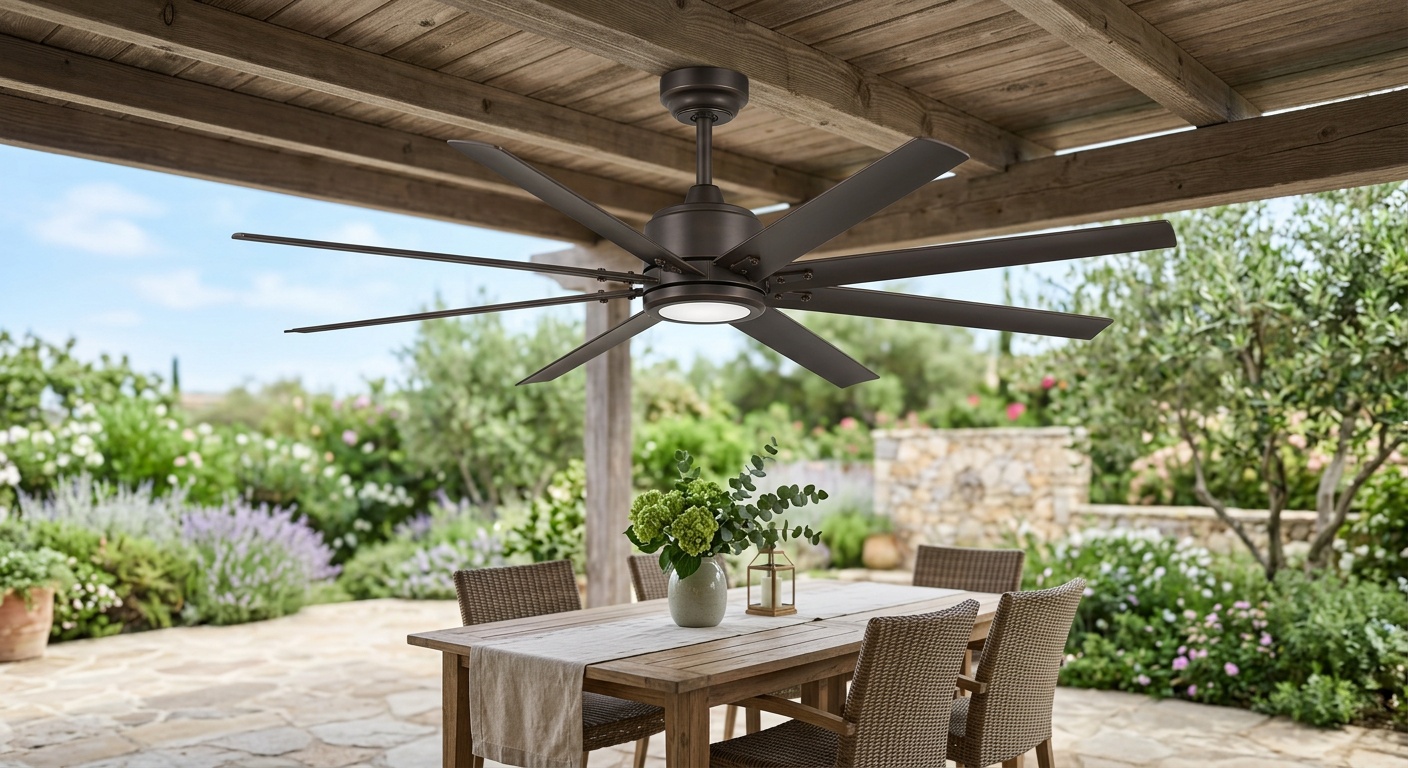
Think about it like this: imagine you’re setting up a fan on a 100-square-foot covered patio with a pergola overhead. A standard 52-inch ceiling-mount outdoor fan positioned centrally will move air in a complete circular pattern across every seat at that table. No dead zones, no hot corners, no one suffering while someone else stays comfortable.
Energy Efficiency You Can Actually Measure
Outdoor ceiling fans rated by Energy Star in 2026 consume between 15 and 75 watts, depending on speed setting. Compare that to even the most efficient portable AC unit, which draws a minimum of 500 watts. For an 8-hour evening on the patio, that’s the difference between spending roughly $0.06 versus $0.40 in electricity — a 570% cost gap that compounds significantly over a summer season.
Types of Outdoor Fans to Consider
Not all outdoor fans are created equal, and choosing the wrong type for your specific patio setup is the single most common mistake buyers make. Let’s break down your options with precision.
Ceiling-Mount Outdoor Fans
These are the gold standard for covered patios. If your patio has a pergola, overhang, or solid ceiling, a ceiling-mount fan offers the best combination of airflow volume, aesthetic integration, and long-term reliability. Look for fans rated UL Wet (fully waterproof) if your patio is exposed, or UL Damp for covered areas with indirect moisture exposure.
Key specs to prioritize:
- Blade span: 44–52 inches for patios up to 200 sq ft
- CFM (Cubic Feet per Minute): Minimum 4,000 CFM for meaningful cooling
- Motor type: DC motors are significantly quieter and more efficient than AC motors
- IP rating: IP44 minimum for covered outdoor use; IP55+ for open exposure
Tower Fans for Patios
If you don’t have an overhead mounting surface, tower fans are your best friend. Modern outdoor-rated tower fans in 2026 are dramatically improved over their predecessors — many now feature bladeless designs, app-controlled oscillation, and weather-resistant casings. They’re portable, which means you can reposition them based on wind direction and seating arrangement.
The trade-off: tower fans move less air volume than ceiling fans of equivalent price, and they’re more susceptible to tipping in gusty conditions. Always look for a weighted base or stake anchor system for outdoor tower fans.
Misting Fans
Here’s where things get interesting for extreme heat scenarios. Misting fans combine airflow with ultra-fine water droplets that evaporate on contact with your skin, delivering evaporative cooling that can drop perceived temperatures by 10–25°F in low-humidity environments. In arid climates like Arizona, Nevada, or Southern California, misting fans are arguably more effective than any other non-AC solution.
Important caveat: in high-humidity regions (the Gulf Coast, Florida, the Southeast), misting fans lose most of their effectiveness because the air is already saturated with moisture and evaporation becomes sluggish. Know your climate before investing here.
Pedestal and Box Fans
Budget-friendly and highly flexible, pedestal fans are a practical entry point for patio cooling. They’re not the most powerful option, but a quality outdoor-rated pedestal fan positioned at seating height and aimed directly at your primary seating zone delivers targeted comfort at a fraction of the cost. Box fans work similarly, though they’re better suited to enclosed patio structures where they can be wedged into a doorway or opening to create cross-ventilation.
Top Fan Picks for Small Patios in 2026
Based on current market availability, consumer reviews aggregated through mid-2026, and hands-on performance data from outdoor living publications, here are the standout options across categories.
Best Ceiling Fan: Hunter Dempsey Indoor/Outdoor
The Hunter Dempsey remains a top recommendation in 2026 for good reason. With a 52-inch blade span, DC motor pulling just 22 watts at high speed, and a UL Wet rating, it checks every critical box for covered patio installation. At approximately $180–$220, it delivers premium performance without premium pricing. The reversible motor is a genuine bonus — switch to reverse in winter to push warm air down and extend your patio season.
CFM: 5,498 | Noise level: 42 dB | Wattage: 22W (high speed)
Best Misting Fan: LASKO Outdoor Misting Tower (2026 Edition)
LASKO’s outdoor misting tower, updated in early 2026 with an upgraded oscillation mechanism and a redesigned water reservoir (now 1.5 liters), delivers strong mist coverage across a 15-foot radius. The bladeless design minimizes injury risk in tight spaces, and the IPX4 splash-resistant rating handles light rain without issue. Best suited for patios in dry climates. Retail price: approximately $149.
Best Budget Option: Comfort Zone CZHV18B Box Fan
At under $60, the Comfort Zone CZHV18B doesn’t pretend to be premium — but for a small, partially enclosed patio where you need directed airflow on a tight budget, it’s genuinely hard to beat. Use it wedged in a side opening to pull cooler air in during evening hours, or position it behind a seating area to push a steady breeze forward.
Best Smart Fan: Haiku by Big Ass Fans (H Series)
If budget isn’t a constraint, the Haiku H Series is the definitive premium outdoor ceiling fan available in 2026. At $499–$699 depending on finish, it comes with SenseME technology — an integrated motion and temperature sensor that automatically adjusts fan speed based on room occupancy and ambient heat. The DC motor draws just 6 watts at low speed, and the app integration is genuinely useful rather than gimmicky. For a small patio where you want set-it-and-forget-it comfort, nothing beats it.
Comparison Table: Fan Performance at a Glance
| Fan Model | Type | CFM | Wattage | Price (2026) | Best For |
|---|---|---|---|---|---|
| Hunter Dempsey 52″ | Ceiling | 5,498 | 22W | $180–$220 | Covered patios |
| LASKO Misting Tower | Misting Tower | 2,800 | 45W | $149 | Dry climate patios |
| Comfort Zone CZHV18B | Box Fan | 1,650 | 200W | ~$55 | Budget buyers |
| Haiku H Series | Smart Ceiling | 6,100 | 6–32W | $499–$699 | Premium smart homes |
| Rowenta VU5670 | Pedestal | 3,200 | 60W | $120–$150 | Open patios, portability |
Placement and Setup Strategies
Buying the right fan is only half the equation. Where and how you install it determines whether you get a refreshing breeze or a frustrating hot air shuffle. Let’s get specific.
The Central Overhead Rule
For ceiling-mount fans on covered patios, center is almost always correct. The fan should hang 8–10 feet above the floor for optimal airflow distribution. If your patio ceiling is higher than 10 feet, use a downrod extension to bring the fan closer to occupant level — every foot above 10 feet reduces effective airflow delivery by approximately 10–15%.
Quick scenario: You have a 12×14 foot covered patio (168 sq ft) with a 10-foot ceiling. One 52-inch ceiling fan centered over the main seating area will cover the entire space effectively. You don’t need a second fan. You just need the right one positioned correctly.
Directional Airflow for Open Patios
For open, uncovered patios where ceiling mounting isn’t an option, think about airflow direction strategically. Position your pedestal or tower fan opposite your primary seating — meaning the fan blows toward where people sit, not away from them. Angle it slightly downward (most pedestal fans allow 5–15° of tilt) to direct the airflow across skin level rather than overhead.
For corner patios with two open sides, place the fan in the interior corner and let it oscillate across the full seating arc. This creates a back-and-forth breeze pattern that feels more natural than fixed-direction airflow.
Layering Fan and Shade Together
The most effective small patio cooling setups in 2026 combine fan airflow with physical shade structures. A pergola with 70% shade cloth reduces radiant heat load by up to 47%, which means your fan starts from a cooler baseline. This layering approach — shade first, then airflow — is how professional outdoor designers approach small patio comfort, and it’s something any homeowner can implement over a weekend.
For broader context on room cooling solutions that pair well with outdoor fans, evaporative techniques and smart airflow management are increasingly being applied to semi-enclosed patio spaces with excellent results.
Cooling Effectiveness: Visual Comparison
The chart below compares the perceived temperature reduction (in °F) each fan type delivers under standard summer conditions (90°F, 40% humidity, light breeze):
Perceived Temperature Drop by Fan Type (°F)
~18°F
~10°F
~7°F
~5–6°F
~4°F
*Values are approximate perceived reductions under 90°F, 40% relative humidity conditions. Misting fan value applies to arid climates only.
Common Challenges and How to Solve Them
Challenge 1: Humidity Makes Everything Feel Worse
In high-humidity environments, fans sometimes feel like they’re just moving hot, wet air around. This is a legitimate frustration, and it’s worth addressing directly. The solution isn’t to abandon fans — it’s to pair them with dehumidification.
Compact portable dehumidifiers designed for outdoor-adjacent spaces have improved significantly in 2026. Units from brands like hOmeLabs and Midea now offer outdoor-rated enclosures that can reduce relative humidity on a semi-enclosed patio by 15–20 percentage points. Combine that with a ceiling fan, and you’ve created a genuinely comfortable environment even in muggy conditions. The fan handles perceived temperature; the dehumidifier handles moisture saturation.
Challenge 2: Wind Interference on Open Patios
Natural outdoor wind can either help or hurt your fan strategy. On breezy days, your pedestal or tower fan may be working against ambient airflow rather than with it. The fix: orient your fan to complement the prevailing wind direction, not oppose it. Check which direction the natural breeze comes from in your yard (usually a consistent pattern in any given location) and position your fan on the upwind side, blowing in the same direction as the natural airflow to amplify rather than counteract it.
For gusty days where wind stability is a concern, ceiling-mount fans solve the problem entirely — they’re fixed in place and unaffected by ground-level turbulence.
Challenge 3: Noise Disrupting Conversation and Ambiance
Outdoor fans that create significant noise are a real problem for social spaces. Many cheaper AC-motor ceiling fans emit a noticeable hum at higher speeds. The solution is straightforward: invest in a DC motor fan. DC motors operate at approximately 40–45 dB at high speed versus 55–65 dB for equivalent AC motor models — a difference that’s immediately perceptible in conversation.
For tower and pedestal fans, look for models with “Sleep Mode” or dedicated whisper settings that prioritize noise reduction over maximum airflow. Running two fans on medium-low rather than one fan on high often achieves comparable airflow with significantly less noise.
Frequently Asked Questions
What size outdoor fan do I need for a 150-square-foot patio?
For a 150-square-foot patio, a ceiling fan with a 44–48 inch blade span is generally the right fit. If you’re going above 52 inches in blade span, you risk creating too much turbulence in a compact space, which can be uncomfortable and may knock lightweight outdoor accessories around. The Hunter Dempsey 44″ or any comparable Energy Star-rated fan in that blade range will move sufficient air volume for a space this size. Aim for a CFM rating above 4,000 to ensure coverage without needing to run the fan at full speed constantly.
Can outdoor fans be left outside year-round?
This depends entirely on the fan’s weather rating. Fans with a UL Wet rating are designed for fully exposed outdoor environments and can handle direct rain, humidity, and seasonal temperature swings without significant degradation. UL Damp-rated fans should only be used in covered or sheltered outdoor spaces and should ideally be brought inside or covered during extended periods of heavy rainfall or freezing temperatures. If you’re in a climate with harsh winters, even UL Wet fans benefit from a protective cover during the off-season to extend motor life and prevent finish oxidation.
How many outdoor fans do I need for effective patio cooling?
For most small patios under 200 square feet, one well-positioned ceiling fan is sufficient provided it has adequate CFM for the space. Add a secondary fan (pedestal or tower) only if your patio has irregular geometry — an L-shape, for instance — or if there’s a specific seating zone that the primary fan doesn’t reach effectively. Over-fanning a small space creates conflicting airflow patterns that can actually reduce comfort. Quality and placement beat quantity every time in compact outdoor environments.
Your Patio Cooling Action Plan
Here’s the practical roadmap you need to turn your small patio into a genuinely cool, comfortable outdoor living space — without a single AC unit in sight.
- Step 1 — Assess your space: Measure your patio’s square footage and determine whether it’s covered (ceiling mount is viable) or open (pedestal/tower fan territory). Note your local climate’s typical humidity level.
- Step 2 — Match fan type to space: Covered patio under 200 sq ft? Go DC motor ceiling fan, 44–52 inches. Open patio in a dry climate? A misting fan will deliver the most dramatic cooling. Open patio in a humid climate? Pedestal fan plus dehumidifier is your winning combo.
- Step 3 — Optimize placement before you buy: Identify where your primary seating is and work backward to the optimal fan position. Don’t buy a ceiling fan without confirming your mounting point is centered over that seating zone.
- Step 4 — Layer your cooling: Add shade structure (pergola, sail shade, or umbrella) to reduce the heat load your fan has to counteract. This single step can make a $150 fan perform like a $500 one.
- Step 5 — Run a 30-day comfort test: During peak heat, track which hours your patio becomes uncomfortable and adjust fan speed, direction, and secondary positioning accordingly. Most people find the sweet spot within two weeks of attentive use.
As outdoor living spaces continue to evolve from seasonal luxuries into year-round lifestyle extensions — a trend that’s only accelerating as remote and hybrid work keeps more people at home in 2026 — the ability to cool a small patio effectively without AC isn’t just a comfort upgrade. It’s a quality-of-life investment with measurable returns in energy savings, extended usable hours, and genuine daily enjoyment.
So here’s the question worth sitting with: How many hours of outdoor time have you sacrificed to heat that the right fan could have saved? The answer might be more motivating than any spec sheet.
Article reviewed by Sofia Romano, Flooring & Wall Tiling Geometry Specialist, on June 8, 2026