Pool Decking Material Guide: Travertine vs. Concrete vs. Wood
Reading time: 14 minutes
You’ve finally decided to build or renovate your pool deck — congratulations. Now comes the part that trips up most homeowners: choosing the right decking material. Walk down any suburban street in 2026, and you’ll see the full spectrum — gorgeous travertine surrounds that look like they belong in a Tuscany villa, sleek stamped concrete that doubles a property’s curb appeal, and warm timber decks that make you feel like you’re at a luxury resort.
But here’s the straight talk: every material has a breaking point, and what looks stunning in a showroom brochure can become a maintenance nightmare if it’s wrong for your climate, lifestyle, or budget. This guide cuts through the noise and gives you the precise, practical information you need to make a decision you’ll be happy with a decade from now.
Table of Contents
- Why Your Pool Deck Material Matters More Than You Think
- Travertine: The Timeless Luxury Option
- Concrete: The Versatile Workhorse
- Wood: The Warm, Natural Classic
- Head-to-Head Comparison Table
- Performance Ratings at a Glance
- 3 Common Challenges and How to Overcome Them
- Real-World Case Studies
- Frequently Asked Questions
- Choosing Your Deck: Your Decision Roadmap
Why Your Pool Deck Material Matters More Than You Think
A pool deck isn’t just a surface — it’s the frame around your backyard’s centerpiece. It influences safety (slip resistance matters enormously), comfort (surface temperature on a 95°F summer day varies wildly by material), property value, maintenance burden, and environmental footprint. According to a 2025 report by the Pool & Hot Tub Alliance (PHTA), pool deck renovations account for approximately 38% of all pool-related improvement spending in North America, with homeowners investing an average of $12,000–$28,000 on new decking in 2025.
In 2026, three materials dominate the residential pool deck market: travertine, concrete, and wood. Each has passionate advocates and legitimate critics. The goal here isn’t to declare a winner — it’s to help you identify which one wins for you.
Quick scenario: Imagine you live in Phoenix, Arizona, with three kids under ten and a tight $15,000 budget. Does travertine make sense? Maybe — but only if you know its specific advantages in desert climates. Or picture a lakeside property in Minnesota where freeze-thaw cycles are brutal. Wood sounds romantic, but will it survive? Let’s find out.
Travertine: The Timeless Luxury Option
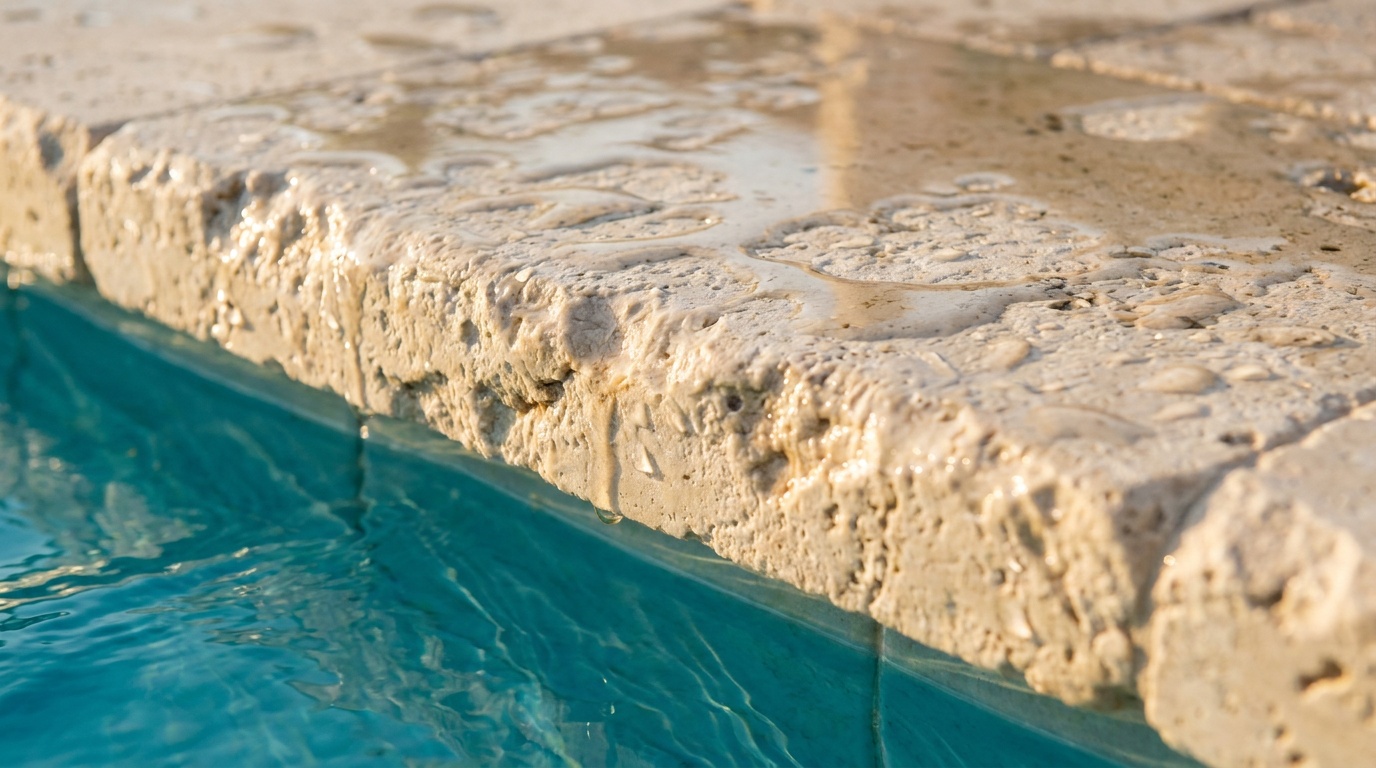
Travertine is a form of limestone deposited by mineral springs. It has been used in construction for thousands of years — the Colosseum in Rome is built largely from it. For pool decks, it brings a level of natural elegance that manufactured materials simply can’t replicate.
What Makes Travertine Stand Out
The biggest functional advantage of travertine around pools is its remarkably cool surface temperature. Its porous structure reflects heat rather than absorbing it, which means it stays significantly cooler underfoot compared to concrete or darker natural stones. In a 2025 thermal comparison study by Outdoor Living Quarterly, travertine surfaces averaged 18–22°F cooler than comparable concrete surfaces under direct afternoon sun — a game-changer for families with barefoot kids running around all day.
Travertine also offers natural slip resistance in its tumbled or brushed finish varieties. Its texture gives adequate grip even when wet, which is a primary safety concern for pool surrounds. Additionally, travertine tiles don’t crack under freeze-thaw conditions the same way dense concrete does, because the porous material allows water to expand within its structure rather than fracturing the stone face.
The Honest Drawbacks of Travertine
Travertine isn’t without its complications. Its porosity — the very quality that keeps it cool — also makes it susceptible to staining and chemical absorption. Pool chemicals, sunscreen, and food spills can penetrate unsealed travertine relatively quickly. Sealing is non-negotiable, and it needs to be reapplied every 1–3 years depending on traffic and sun exposure.
Cost is another real consideration. As of 2026, installed travertine pool decking runs between $15 and $35 per square foot, depending on tile grade, thickness (3 cm pavers are preferable for pool use), and regional labor rates. For a 1,000 sq ft deck, you’re looking at $15,000–$35,000 installed — firmly at the premium end of the spectrum.
Finally, travertine requires professional installation. Improper sub-base preparation or grouting can lead to tiles lifting or cracking within just a few seasons. This is not a DIY-friendly material for most homeowners.
Best Climate Fit for Travertine
Travertine excels in warm, dry climates like the American Southwest, Southern California, Florida, and the Gulf Coast. It performs moderately well in temperate climates with mild winters. It’s the least ideal choice for regions with harsh freeze-thaw cycles (think northern Midwest or New England winters), where its pores can absorb standing water that then freezes and causes surface spalling over time.
Concrete: The Versatile Workhorse
Concrete is the most widely installed pool deck material in the United States — and for good reason. It offers almost unlimited design flexibility, strong structural durability, and a price point that fits nearly every budget tier.
The Many Faces of Pool Concrete
Modern concrete decking in 2026 is nothing like the flat, gray slabs of the 1990s. Today’s options include:
- Stamped concrete: Pressed with patterns that mimic stone, brick, or wood. Costs $8–$18 per sq ft installed.
- Exposed aggregate: A textured surface achieved by washing away the top cement layer to reveal embedded stones. Excellent slip resistance. Costs $6–$14 per sq ft.
- Broom-finished concrete: The most affordable option ($4–$8 per sq ft), with a simple textured surface created by dragging a broom across wet concrete.
- Cool deck coatings: Proprietary spray-on textures applied over concrete that significantly reduce surface temperature. Popular in Arizona and Texas markets.
- Colored and acid-stained concrete: Integral pigments or reactive stains create rich, variegated color effects that age gracefully.
Concrete’s Strengths and Limitations
Concrete’s primary strength is customizability. No other material offers the same range of shapes, colors, textures, and patterns at comparable price points. It bonds seamlessly with the pool shell, allows for custom steps and integrated features, and can be poured in virtually any configuration.
Durability is another genuine advantage. A properly poured and sealed concrete deck will last 25–30+ years with appropriate maintenance. It handles heavy foot traffic, pool furniture, and outdoor barbecue equipment without issue.
The significant drawback? Heat absorption. Plain concrete surfaces can reach 140–160°F under direct summer sun — dangerously hot for bare feet, especially children’s. This is why cool deck coatings and lighter color choices matter enormously in sun-belt states. Additionally, concrete is prone to cracking over time, especially in regions with soil movement or freeze-thaw cycles. Expansion joints can mitigate this, but they don’t eliminate the issue entirely.
Concrete also requires periodic resealing (every 2–5 years) and can be slippery when smooth-finished and wet — a major safety concern. Always specify a textured or broomed finish for pool surrounds.
Best Climate Fit for Concrete
Concrete is a strong performer across most climates but benefits most from being paired with cool-coating treatments in hot, sunny regions. In colder climates, concrete with proper expansion joints and quality sealing handles freeze-thaw reasonably well, though surface etching and minor cracking are common over time.
Wood: The Warm, Natural Classic
Wood decking brings a warmth and organic beauty that stone and concrete simply cannot match. There’s a reason luxury resorts and high-end residential designers reach for timber — it creates an emotional atmosphere, a sense of connection to nature, that elevates the entire outdoor living experience.
Natural Wood vs. Composite: Understanding Your Options
In 2026, “wood” pool decking actually breaks into two distinct categories:
Natural hardwoods — such as Ipe (Brazilian walnut), teak, cedar, and redwood — are the traditional choice. Ipe in particular has become the gold standard for premium pool decks. It’s extraordinarily dense (it doesn’t float in water), naturally resistant to rot, insects, and UV degradation, and develops a beautiful silvery patina if left unfinished. Installed costs for Ipe decking run $25–$45 per sq ft, making it the most expensive option in this guide.
Composite decking — blending wood fibers with recycled plastics — has advanced dramatically in the past five years. Brands like Trex, TimberTech, and Deckorators now produce composite boards that are genuinely difficult to distinguish from natural wood at a glance, while offering significantly better moisture resistance and lower maintenance requirements. Composite pool decking costs $10–$22 per sq ft installed in 2026, positioning it as a mid-range option.
Wood’s Emotional Appeal and Practical Reality
Here’s the honest picture: natural wood decks are beautiful and demanding. Softwoods like cedar and redwood require annual cleaning and resealing to prevent graying, splintering, and rot. Even hardwoods like Ipe need periodic oiling (every 1–2 years) to maintain their rich color, though they’ll survive neglect far better than softer species.
Wood — particularly composite — stays cooler than concrete in direct sun due to lower thermal mass, though not as dramatically cool as travertine. It provides a naturally comfortable surface underfoot, slightly forgiving compared to stone. For families with young children who tumble and roll around the deck, this softness is a genuine safety and comfort advantage.
The critical vulnerability of natural wood is moisture management. Wood decks must be elevated and properly ventilated underneath to allow airflow and prevent moisture accumulation, which leads to rot, mold, and structural degradation. In humid climates like Florida or the Gulf Coast, this is a serious, ongoing concern that requires diligent maintenance and quality installation.
Best Climate Fit for Wood
Natural hardwoods like Ipe perform exceptionally well in temperate to warm climates — the Pacific Northwest, Mid-Atlantic states, and the upper South. Cedar and redwood are more climate-sensitive but work well in dry western climates. Composite decking is the most climate-versatile option and handles humidity better than natural wood. In freeze-thaw zones, composite generally outperforms natural softwoods significantly.
Head-to-Head Comparison Table
| Metric | Travertine | Concrete | Natural Wood | Composite Wood |
|---|---|---|---|---|
| Cost (installed/sq ft) | $15–$35 | $4–$18 | $25–$45 | $10–$22 |
| Lifespan (with care) | 25–50 years | 25–30 years | 15–25 years | 25–30 years |
| Heat Resistance | ⭐⭐⭐⭐⭐ | ⭐⭐ (plain) / ⭐⭐⭐⭐ (coated) | ⭐⭐⭐ | ⭐⭐⭐ |
| Maintenance Level | Moderate | Low–Moderate | High | Low |
| Slip Resistance (wet) | Excellent | Good (textured) | Moderate | Good |
Performance Ratings at a Glance
Here’s how each material stacks up on our composite Overall Suitability Score — a weighted average across cost-efficiency, durability, heat comfort, maintenance, and aesthetic flexibility (rated out of 100):
Scores reflect average conditions across all climates and budget tiers. Individual results vary significantly by region and use case.
3 Common Challenges and How to Overcome Them
Challenge 1: Overheating Surfaces That Burn Bare Feet
This is the single most common complaint from pool deck owners in hot climates. The solution isn’t just choosing travertine and calling it a day — it’s understanding thermal dynamics and designing accordingly.
If you love the look of concrete but are in a hot climate, specify a cool deck coating (such as Kool Deck by Mortex or similar elastomeric coatings) in a light color. These products can reduce surface temperatures by 30–40% compared to uncoated gray concrete. Alternatively, embedding light-colored aggregate into the concrete surface reflects solar radiation effectively. For wood lovers in hot climates, composite boards with heat-dispersing cap layers — a technology refined significantly between 2023 and 2025 — now perform markedly better than older composite products.
Challenge 2: Maintaining Structural Integrity Through Freeze-Thaw Cycles
If you live north of the 40th parallel, freeze-thaw stress is real and it degrades pool decking faster than most homeowners anticipate. Water seeps into micro-pores and surface cracks, freezes, expands, and slowly destroys the surface.
For concrete in freeze-thaw climates: use air-entrained concrete mixes (typically 5–7% air entrainment), proper expansion jointing every 8–10 feet, and penetrating sealer (not film-forming) that allows vapor transmission. For travertine in cooler climates: use filled travertine (factory-filled pores) rather than unfilled, and apply penetrating sealer annually without exception. Composite wood is your safest bet in extreme freeze-thaw regions — it simply doesn’t absorb water the way natural materials do.
Challenge 3: Balancing Aesthetics with Long-Term Budget Reality
Many homeowners make the mistake of calculating only installation costs, ignoring the total cost of ownership over 20 years. A beautiful Ipe deck installed for $35,000 might cost an additional $8,000–$12,000 in oiling, cleaning, board replacement, and repairs over two decades. Conversely, a $10,000 composite deck with minimal maintenance needs might actually deliver better financial value over the same period.
Pro tip: Request a 20-year cost projection from your contractor that includes estimated maintenance cycles, material replacement rates, and refinishing costs. Any reputable pool deck installer in 2026 should be able to provide this analysis. If they can’t — or won’t — that’s a red flag worth heeding.
Real-World Case Studies
Case Study 1: Scottsdale, Arizona — Travertine Triumph
The Meredith family in Scottsdale replaced their 15-year-old stamped concrete deck with 3cm travertine pavers in summer 2025. Their 1,200 sq ft deck had been reaching surface temperatures of 148°F during afternoon peak hours — effectively unusable from noon to 4 PM for their three kids. After switching to brushed travertine in a classic ivory tone, their surface temperature measurements dropped to 112°F under the same conditions — still warm, but manageable. “The kids actually use the deck now,” said homeowner Rachel Meredith. “Before, it sat empty during the best swimming hours of the day.” Total installation cost: $31,200. They report zero cracking or surface issues through their first Arizona summer and winter cycle.
Case Study 2: Charlotte, North Carolina — Composite Wood Renovation
A pool renovation contractor in Charlotte, NC, completed a project in early 2026 replacing a rotting cedar deck around a 20-year-old pool with TimberTech AZEK composite decking in a teak-look finish. The original cedar had been beautiful but required annual stripping and resealing that the homeowners — both working professionals — consistently neglected. Within eight years, sections were soft, discolored, and structurally questionable. The composite replacement at $18,500 installed looks virtually identical to natural wood, has a 50-year fade-and-stain warranty, and requires nothing more than an annual soap-and-water wash. “We wish we’d done it ten years ago,” the homeowners reported. Two seasons in, the deck shows zero degradation.
Case Study 3: Chicago, Illinois — Concrete That Held Up
A landscape contractor in the Chicago western suburbs completed a stamped concrete pool deck project in 2024 using air-entrained concrete with fiber mesh reinforcement, a color hardener in sandstone tan, and a breathable penetrating sealer. After two Chicago winters — including a polar vortex event in January 2025 — the deck showed only minor joint hairlining that was expected and planned for. The homeowners paid $11,800 for their 900 sq ft deck, and it remains in excellent condition heading into 2026. The contractor emphasized the importance of proper sub-base compaction and control joint placement as the difference between a deck that lasts and one that fails prematurely.
Frequently Asked Questions
Is travertine safe around pools, or is it too slippery when wet?
Travertine in tumbled, brushed, or chiseled finishes is genuinely slip-resistant when wet and is considered one of the safer pool deck surfaces available. The key distinction is the finish: polished travertine is dangerously slippery when wet and should never be used around pools. Always specify tumbled or brushed travertine for pool surrounds, and ensure the installer uses a non-slip grout joint. In independent slip-resistance testing using the DCOF (Dynamic Coefficient of Friction) standard required by most building codes in 2026, properly finished travertine consistently meets and exceeds the minimum 0.42 rating for wet areas.
How long does concrete pool decking really last, and what causes it to fail early?
Properly installed concrete pool decking lasts 25–30 years in most climates. Early failure — meaning cracking, spalling, or surface delamination within 5–10 years — almost always traces back to one of three causes: inadequate sub-base preparation (the concrete settles unevenly), insufficient expansion jointing (thermal movement cracks the slab), or improper water-to-cement ratio during mixing (too much water weakens the final product). A fourth emerging issue in 2026 is deicing salt damage in northern climates — pool owners who allow salt-contaminated winter runoff to sit on concrete accelerate surface spalling dramatically. Penetrating sealer applied every 2–3 years is the most effective preventive maintenance step for concrete longevity.
Can I mix materials — for example, concrete with wood accents — or does that create problems?
Mixed-material pool decks are not only possible — they’re increasingly popular in 2026 and can offer genuine functional advantages. A common and attractive combination is concrete or travertine as the primary surface with composite wood used for pergola decking, step accents, or built-in bench platforms. The important considerations are: ensure proper expansion gaps between dissimilar materials (they expand and contract at different rates), use appropriate fastening systems that account for movement, and choose materials with compatible maintenance schedules so you’re not sealing one surface every year while the adjacent surface requires something entirely different. Consult with a contractor experienced in mixed-material installs — this is a specialized skill set, and poor detailing at material transitions is a common failure point.
Choosing Your Deck: Your Decision Roadmap
Here’s the reality check you need before you finalize anything: there is no universally “best” pool deck material. The best choice is the one that aligns your climate, lifestyle, aesthetic preferences, and budget into a coherent, realistic plan. Use this roadmap to lock in your decision:
- Assess your climate first, everything else second. If you’re in a freeze-thaw zone, composite or properly prepared concrete should be your shortlist. If you’re in the desert Sun Belt, travertine deserves serious consideration. Climate compatibility beats aesthetic preference every time.
- Be honest about your maintenance tolerance. Ask yourself: will you actually oil a wood deck every 18 months? Will you remember to reseal your travertine before winter? If the answer is “probably not,” composite or sealed concrete gives you the best longevity with the least behavioral demand.
- Calculate 20-year total cost of ownership, not just installation price. The cheapest install often isn’t the cheapest long-term choice. Get this number before you commit.
- Get at least three quotes from contractors who specialize specifically in pool decking — not general concrete or landscaping contractors. Pool surround installation has unique demands around drainage, chemical exposure, and joint detailing that generalists often underestimate.
- Request material samples and visit completed projects in your neighborhood or climate zone. Seeing how a surface ages in your specific environment — after 5, 10, or 15 years — is worth more than any brochure photo.
The outdoor living space market continues to evolve rapidly in 2026, with sustainability increasingly driving material choices — recycled composite products, locally sourced stone, and low-VOC sealers are all gaining market share as homeowners align their renovation choices with broader environmental values.
Ultimately, your pool deck is one of the highest-use surfaces in your home — baked by sun, splashed with water, trafficked by bare feet for decades. Choose it with the same care and research you’d apply to any major structural investment, and it will reward you with comfort, beauty, and value for years to come. So — which material spoke to you most in this guide, and what’s the one factor you hadn’t considered before reading it?
Article reviewed by Sofia Romano, Flooring & Wall Tiling Geometry Specialist, on May 4, 2026